
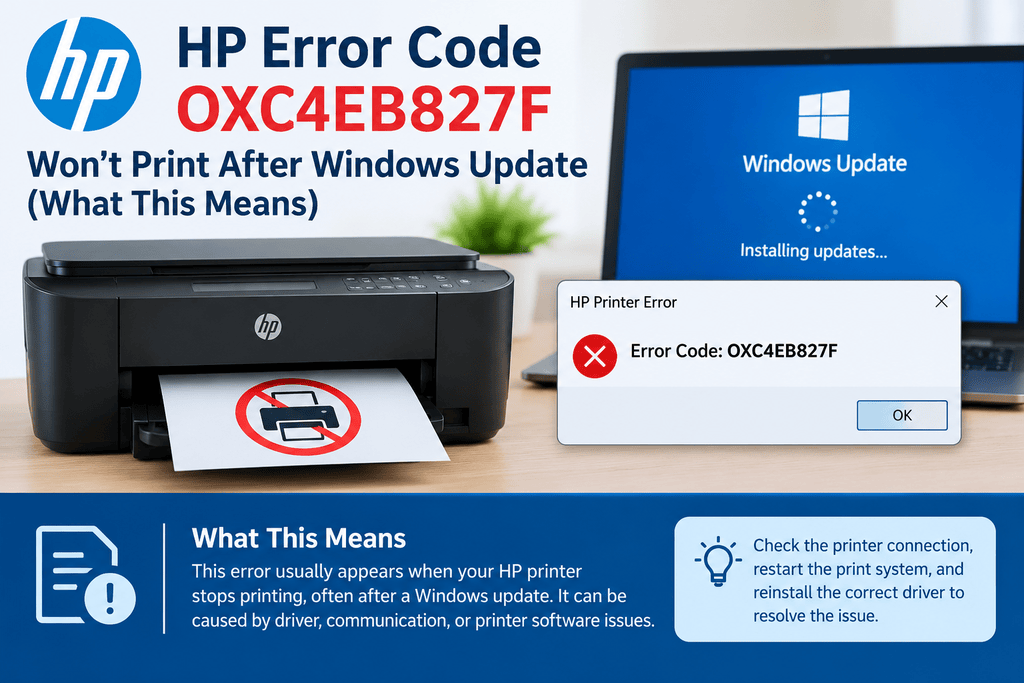
If HP Error Code OXC4EB827F — won’t print after Windows update (what this means) is the problem you’re facing, the timing matters. A printer that worked before a Windows update but stops afterward may have a changed driver, print queue, printer configuration, or communication component.
However, the update is not automatically the cause. The most useful approach is to determine whether the error appears on the printer itself, in Windows, or only when a print job is sent.
Quick Answer
HP error OXC4EB827F appearing after a Windows update does not by itself prove that Windows caused a hardware failure. First determine whether the printer can operate normally without a computer print job. Then restart the printer and PC, clear stuck print jobs, verify the selected printer and connection, and check the installed printer driver. If Windows recently replaced or changed the printer driver, removing and re-adding the printer may restore communication. Exact menus and recovery steps vary by Windows version and HP printer model.
What Does This Mean?
A Windows update can change components that affect printing, including printer drivers, print services, device discovery, and printer configuration.
A printer driver is the software that allows Windows to translate a document into instructions the printer understands. If the driver becomes incompatible, damaged, or replaced during an update, Windows may still show the printer as installed while print jobs fail.
The important distinction is where HP Error Code OXC4EB827F appears.
- If the code appears directly on the printer’s display, investigate the printer and its model-specific documentation first.
- If Windows displays the message, investigate the Windows printing system, driver, and printer connection.
- If the printer shows the error only after receiving a print job, both the computer and printer sides may need investigation.
The code should not be treated as proof of one specific failed component without knowing the exact HP printer model and circumstances.
Symptoms vs. possible causes
| Symptom | Possible area to investigate |
|---|---|
| Error appears immediately on printer startup | Printer initialization or hardware state |
| Error appears only when printing from Windows | Driver, queue, or communication |
| Printer is listed but jobs remain pending | Windows print queue or Print Spooler |
| Printer shows offline after update | Connection or printer configuration |
| Printer works from its own control panel but not Windows | Computer-side printing problem |
| Printer prints from another device | Windows-specific driver or configuration |
| Printer makes unusual mechanical sounds | Printer-side mechanical issue |
These are diagnostic clues rather than guaranteed causes.
Common Causes
1. A printer driver changed during the update
Windows may install, replace, or modify printer software as part of system maintenance. A driver that no longer communicates correctly with a particular HP model can cause printing failures.
2. A stuck print queue
An interrupted job can remain in the Windows queue and prevent subsequent documents from printing. This can make a healthy printer appear broken.
3. The printer was reconfigured
After an operating-system update, Windows may change how a printer is identified or configured. This can be especially noticeable with network printers.
4. Windows Print Spooler problems
The Print Spooler is a Windows service that manages print jobs. If it stops working correctly, documents may remain stuck or fail to reach the printer.
5. Network or USB communication changed
An update may coincide with changes to networking, device discovery, or USB behavior. The printer can remain visible in Windows without having a working print connection.
6. The error is unrelated to Windows
This possibility is important. If the printer displays OXC4EB827F independently of the computer, a Windows update may simply have happened around the same time as an unrelated printer problem.
Step-by-Step Solutions
1. Determine where the error appears
Start by identifying the source of the message.
Is OXC4EB827F shown:
- On the printer’s touchscreen or display?
- In Windows?
- In an HP application?
- Only after clicking Print?
This determines which troubleshooting path makes the most sense.
2. Restart both devices
Save your work, cancel any pending print jobs, and restart the computer.
Then restart the printer normally and allow it to complete its startup sequence.
This can clear temporary communication problems and restart the Windows printing components.
A restart is less likely to solve a persistent hardware fault, but it is a sensible first check.
3. Check the Windows print queue
Open the printer’s queue in Windows and look for documents that are stuck.
Cancel pending jobs and then send a small test document.
If a job refuses to clear, the Windows Print Spooler may need to be restarted. The exact procedure can vary between Windows releases.
4. Confirm the correct printer is selected
Windows may have multiple printer entries, particularly after software changes.
Check Settings > Bluetooth & devices > Printers & scanners and select the intended HP printer.
Also check the application’s print dialog. Make sure the document is not being sent to an old, duplicate, offline, or virtual printer.
5. Check the connection
For a USB printer:
- Reseat the USB cable.
- Try another compatible USB port if available.
- Avoid using an unreliable hub while troubleshooting.
For a Wi-Fi printer:
- Confirm that the printer is connected to the intended network.
- Check whether other devices can communicate with it.
- Verify that Windows is using the correct printer entry.
Network menu names vary by HP model.
6. Print a test page or printer report
If your HP printer provides a built-in test, diagnostic, or information report, try printing it from the printer’s own controls.
This is a valuable isolation test.
If the printer can produce its own report but Windows documents fail, focus on the PC, driver, queue, or connection.
If the printer cannot print its own report, investigate the printer itself before concentrating on Windows.
7. Remove and re-add the printer
If the basic checks fail, remove the printer from Windows and add it again.
This can rebuild the Windows printer configuration and may help when an update left an outdated or incorrect device entry.
Before removing it, note the exact printer model and connection method. The procedure can differ for USB and network printers.
8. Check the printer driver
If the problem began immediately after a Windows update, compare the current printer driver situation with the printer manufacturer’s supported software for your exact model.
Do not install a random driver simply because its name looks similar. HP printer families can require different software.
Driver instructions also vary by Windows version.
9. Test another application or device
Try printing a simple page from another Windows application.
If possible, test the printer from another computer or supported device.
These tests help establish whether the problem is specific to one application, Windows installation, or the printer itself.
10. Consider Windows recovery options carefully
If printing worked immediately before a major Windows change and stopped afterward, Windows provides recovery and update-management options that may be relevant.
However, do not remove security or system updates simply as a first troubleshooting step. First establish that the update is actually related to the printing failure and check for a compatible printer driver or configuration fix.
Solution, difficulty, and estimated time
| Solution | Difficulty | Estimated time |
|---|---|---|
| Identify where the error appears | Easy | 1–3 minutes |
| Restart printer and PC | Easy | 3–5 minutes |
| Clear print queue | Easy | 2–5 minutes |
| Check printer selection | Easy | 2–5 minutes |
| Check USB or Wi-Fi connection | Easy | 3–10 minutes |
| Print a built-in test page | Easy | 2–5 minutes |
| Remove and re-add printer | Moderate | 5–15 minutes |
| Check/reinstall supported driver | Moderate | 10–20 minutes |
| Investigate Windows recovery options | Advanced | Varies |
Tips to Prevent the Problem
You cannot prevent every Windows printing issue, but a few practices make troubleshooting easier.
- Keep a note of your exact HP printer model.
- Use printer software intended for that model and Windows version.
- Avoid maintaining several duplicate printer entries unnecessarily.
- Keep the printer connected to a stable Wi-Fi network.
- Clear failed print jobs rather than repeatedly resending the same document.
- Check the printer manufacturer’s compatibility information before major operating-system changes.
- Keep important printer drivers available when managing a computer with a critical printing requirement.
- After a major Windows update, test important peripherals before an urgent printing task.
Remember that printer menus, driver packages, and Windows settings can change between versions. Always use instructions appropriate for your particular configuration.
Frequently Asked Questions
What is HP error code OXC4EB827F?
OXC4EB827F is an HP printer error code, but the correct interpretation depends on the printer model and where the error is displayed. The code alone should not be used to diagnose a specific failed component.
Why did OXC4EB827F appear after a Windows update?
The update may have changed printer drivers, services, configuration, or device communication. However, timing alone does not prove that Windows caused the error.
Could a Windows update break my HP printer driver?
Yes, an update can change or replace software involved in printing. If the printer stopped working immediately afterward, driver compatibility and the Windows print system are reasonable areas to check.
Should I reinstall my HP printer first?
Not necessarily. First restart the printer and PC, clear the print queue, verify the selected printer, and test the connection. Reinstalling can be useful if those steps do not resolve the problem.
What if my printer works but Windows says it is offline?
Check the printer’s network or USB connection and confirm that Windows is using the correct printer entry. A saved printer entry can remain visible even when communication is no longer working.
How do I know if the problem is Windows or the printer?
Try a printer-generated test or information page. If that works but Windows documents fail, the computer-side printing system becomes more likely. If the printer cannot print its own report, investigate the printer itself.
Can a stuck print queue cause the error?
A stuck queue can prevent printing, although it does not necessarily explain every occurrence of a particular HP error code. Clear pending jobs before moving to more complicated troubleshooting.
Should I roll back the Windows update?
Do not make rollback the first step. Establish whether the update is actually responsible, check for a compatible printer driver, and use standard printer troubleshooting first.
Why does the printer work from another computer?
If the same printer works from another device, the printer hardware may be functioning normally. That result points toward the original Windows computer, its driver, queue, or configuration.
Does the solution work for every HP printer?
No. HP printer models use different hardware, firmware, controls, and software. Instructions for one model may not apply to another, so model-specific documentation should take priority.
Final Thoughts
If HP Error Code OXC4EB827F — won’t print after Windows update (what this means) describes your situation, do not assume that the Windows update permanently damaged the printer. First determine where the error appears and whether the printer can produce a built-in test page.
Then work through the basics: restart the printer and PC, clear the Windows print queue, confirm the correct printer, check the connection, and investigate the driver. If the printer works independently but Windows cannot print, focus on the computer-side configuration. If the error appears directly on the printer, use the exact model’s HP troubleshooting guidance.
The timing of the Windows update is useful evidence, but the specific printer model, location of the error, and behavior during testing are more useful for identifying what actually changed.


Leave a Reply